
Pumps rebuilt to their rated flow again.
Industrial pumps torn down, measured and rebuilt with the internal clearances restored: wear rings, impeller, shaft and seals brought back to spec, so the pump makes its rated flow and head again, without leaks or cavitation damage carrying on.
- Centrifugal, end-suction, vertical and process pumps
- Mechanical seals and packing replaced
- Impellers repaired, balanced or replaced
- Wear ring and casing clearances restored
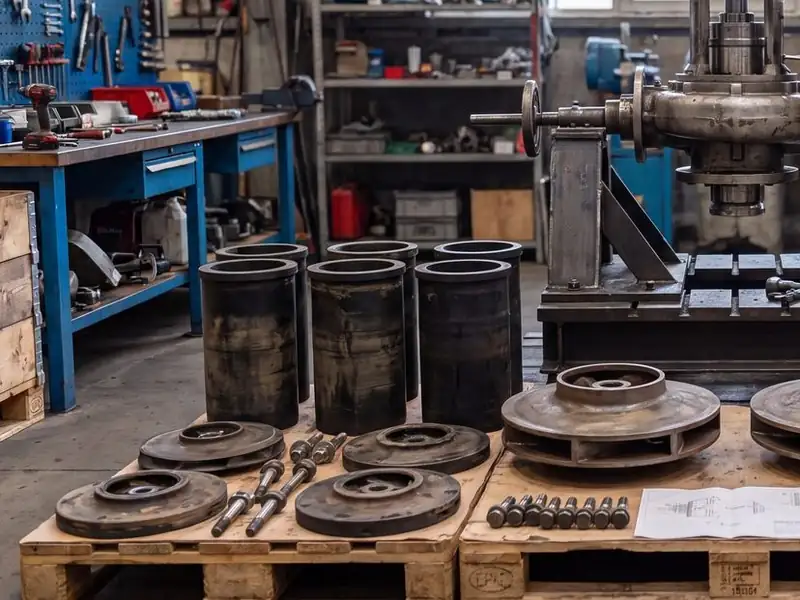
The whole pump, measured against spec.
Most pump failures finish at the bearings or the seal. The rebuild fixes what wore out and what made it wear.
Rebuild work
- Teardown and inspection: impeller, wear rings, shaft, bearings, seal chamber and casing
- Internal clearances measured against spec and restored by machining or new parts
- Shafts straightened, sleeved at the seal area, or made new
- Casings built up and re-machined where corrosion or erosion opened the clearances
- Rotating assembly balanced; pump reassembled and checked for free rotation
Seals, bearings & alignment
- Mechanical seal replaced, with the face and elastomer condition of the old seal reported
- Bearings replaced with fits and lubrication checked
- Coupling and alignment guidance for reinstalling: the most common cause of repeat vibration
- Operating point flagged: a pump run far from its best efficiency point wears fast, and the wear pattern shows it
Frequent seal failures are rarely a bad seal.
They’re usually a shaft, alignment or operating-point problem. We inspect the removed seal and the shaft sleeve and tell you what we find: seal faces show dry running, misalignment and contamination clearly. Fixing the cause is part of the rebuild, so you don’t pay for the same repair twice.
- Seal faces and elastomers, read and reported
- Shaft and sleeve under the seal, checked for wear and runout
- Alignment and operating point, flagged when the wear pattern shows them
- Bearing fits and lubrication: most pump failures finish at the bearings
Signs a pump needs repair.
A pump usually tells you before it seizes.
- 01Leaking at the shaftMechanical seal faces worn or damaged, or packing at the end of its life.
- 02Flow or pressure downWear ring and impeller clearances have opened up; flow slips back inside the casing.
- 03Noise like gravelCavitation from a suction problem. It eats the impeller if it keeps running.
- 04VibrationMisalignment, impeller damage or imbalance, or worn bearings.
- 05Hot bearing housingLubrication failing or bearings wearing out: an early warning before a seizure.
- 06Frequent seal failuresUsually a shaft, alignment or operating-point problem, not a bad seal.
Not sure what it is? Try the troubleshooter or tell David what the pump is doing.
Before you send the pump.
What should come in with the pump?
Can a worn casing be repaired, or is it scrap?
Why did the seal fail?
Same shop, same teardown first.
Tell us what’s down.
It goes straight to David. Nameplate photos go by text, one tap after you send.
- 1David reads itYour request lands with him right away, with the equipment and urgency you picked.
- 2Send a nameplate photoAfter you send, one tap opens a text to (346) 429-7753 for the photos.
- 3Bring it in, get a straight quoteIt’s torn down and inspected, and you get the price and timing before any work starts.
Line down? Pick “Down now”. Equipment that is down gets priority.
The shop: 6922 La Paseo St, Houston, TX 77087.